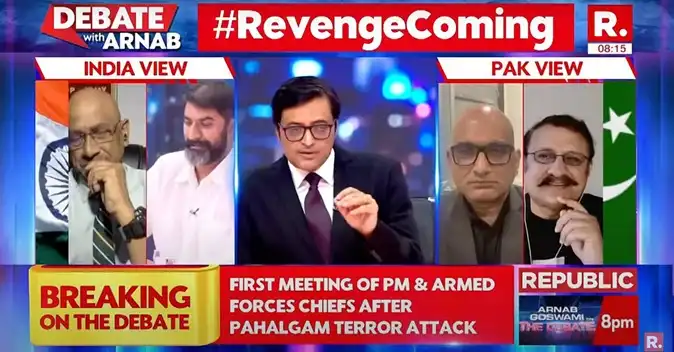
In recent years, a strange and troubling pattern has taken root in many television news channels in our Bharat. For long hours each day—sometimes stretching close to twenty hours—screens are filled with debates, visuals, shouting panels, and breaking news centered almost entirely on Pakistan. The repetition is relentless. Morning shows, afternoon discussions, prime-time debates, and even late-night slots return to the same country, the same tone, and the same emotions. What is shown repeatedly becomes familiar, and what becomes familiar slowly shapes thought. When young minds grow up watching Pakistan being discussed day and night—mostly in the language of hostility, ridicule, or confrontation—they absorb more than facts. They absorb attitudes. They learn that anger is normal, that shouting is debate, and that another nation must constantly occupy our mental space. This is not healthy learning; it is emotional conditioning.
One must ask a basic question: why should Pakistan dominate our electronic media news cycle to such an extent? Do you think it’s the most important topic in the lives of Indians? Is it representative of what Indian citizens experience on a daily basis, including the challenges that we face, and the goals that we’ve set, as people? India as a country offers a wide variety of stories, from the development of its physical assets to the development of its intellectual assets, and everything in between; including social agendas (e.g. social justice, caste discrimination) and the advancement of technology (e.g. transitioning to a digital economy). Many of these stories are ignored in favour of repeating the same negative electronic media coverage surrounding Pakistan.
The younger generation, particularly adolescents and university attendees, are in a transition stage in their lives. They are forming their views of the world and are developing their understanding of the political process, national identity, and their own identity. When a large part of what these younger people are exposed to when it comes to international events is the negative reports about Pakistan, and the constant comparisons, the scope of their worldview is restricted. They lose an opportunity to build a sense of self through the achievement of their goals and are forced to form their sense of identity through comparison to others. This type of shortcut to nationalism can be dangerous because it relies more on denouncement of others rather than establishing respect for themselves.
There is also the psychological cost of continuous exposure to aggressive content. The constant presence of loud debates, outrageous imagery, language that resembles a war, and unpredictable predictions doesn’t promote peace but, instead, anxiety among young audiences, many of whom may not actively track what is happening politically. Young viewers may feel the pressure of that tension even if they don’t realize it consciously and, over time and with influence from various media outlets, the pressure causes emotional exhaustion and a sense of scepticism toward politics and international affairs. News should inform and educate, not keep society in a permanent state of agitation.
Another serious concern is the normalisation of hate. When a country is constantly shown only through a negative lens, it becomes easy to extend that negativity to people, cultures, and even individuals. Young minds may begin to associate entire populations with hostility or blame, forgetting that ordinary people across borders also struggle, dream, and live complex lives. This kind of thinking does not strengthen Bharat; it weakens our moral and intellectual confidence.
Ironically, by placing such excessive emphasis on Pakistan in the national dialogue, we have also given it undue importance by placing so much priority on this topic in national discussions. By placing such importance on it, we allow Pakistan to control more of our mental energy and media space. A nation that feels secure in its identity does not feel the need to continually define itself in relation to another nation. True strength comes from focusing on your own development, addressing your own weaknesses, and creating institutions that serve the needs of your citizenry.
Furthermore, this has created an educational deficit. News channels could be excellent forums for civic education through the use of a straightforward approach to discussing policy, demonstrating successful examples of how to govern effectively and fostering grassroots creativity, and sensitively discussing social issues and problems. Instead, most of the airtime and resources devoted to this area are being wasted on redundant arguments that contribute little in terms of new information, and virtually nothing in terms of wisdom or insight.
Young people do not have access to much detailed discussion about education reform, healthcare issues, climate change, employment trends, and technology. The role of scientists, educators, entrepreneurs, farmers, and social workers who are shaping India’s future through their quiet and diligent contributions is not often publicized adequately. When these role models are not visible in the media, the notion of success is distorted. Media houses are social institutions with ethical responsibilities. If content that spreads anger and obsession is profitable, that does not automatically make it right. History reminds us that the media has always played a crucial role in shaping societies—for better or for worse. Bharat has always valued dialogue, restraint, and wisdom. Our civilisational ethos teaches us to focus on self-improvement rather than constant comparison. When the media abandons this ethos, it disconnects the present generation from deeper cultural values of balance and maturity.
Equally important is the need to consciously amplify stories of national development. Let young viewers see how roads are built, how startups grow, how villages transform, how policies impact lives. Let them watch debates on education quality, environmental responsibility, and ethical leadership. These are the discussions that shape builders, not just spectators. Media houses must introspect on their long-term role. Short-term ratings cannot come at the cost of long-term social health. The youth of Bharat deserve content that informs their minds, not inflames their emotions. They deserve exposure to complexity, not constant provocation.
(email: profjasimmd@gmail.com)
Author

Professor, Aligarh Muslim University & ex-Group Editor Sahara News Network