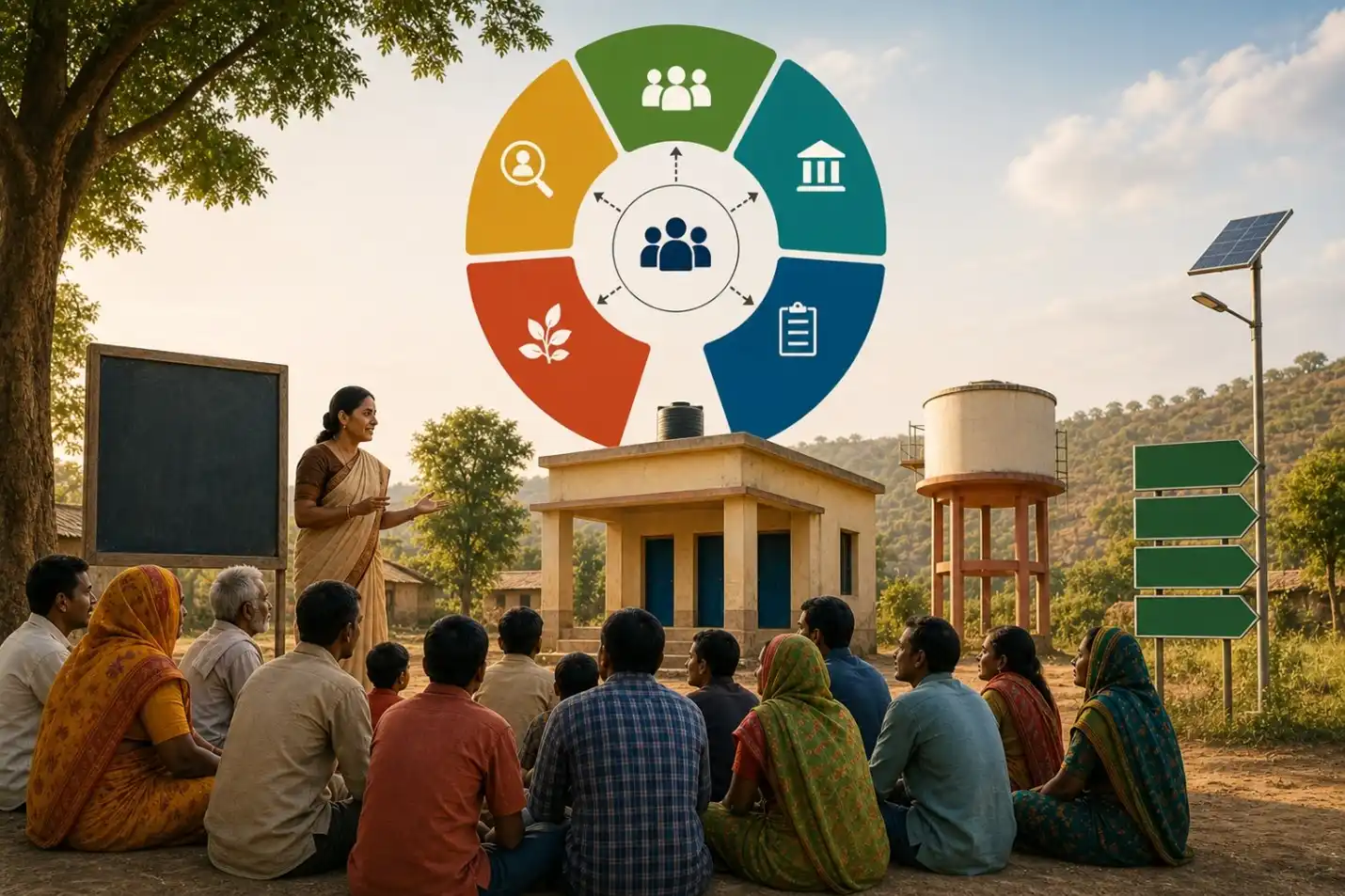
When India extended democratic decentralisation to tribal regions through the Panchayats Extension to Scheduled Areas Act, 1996, it acknowledged a simple but powerful reality that governance in tribal societies did not begin with the Constitution. For generations, tribal communities have governed themselves through institutions rooted in consensus, customary norms, and collective decision making. Observations from Jhabua district in Madhya Pradesh show that village governance continues to be shaped not only by elected Sarpanches but also by traditional village heads such as Patels and Tadvis. Welfare delivery decisions, dispute resolution processes, and local development initiatives often acquire legitimacy only when endorsed by these customary authorities. The future of decentralisation in tribal India will therefore depend on whether democratic institutions can coexist with these deeply embedded governance traditions.
In Jharkhand, community decision making continues to be mediated through institutions such as Mundas, Manjhis, and Parha. In Chhattisgarh and Odisha, village governance frequently involves Gaon Mukhiyas, clan elders, and traditional councils. Government reviews of PESA implementation have noted that such leadership systems historically regulated land ownership, resolved social conflicts, and managed forest resources long before formal Panchayat systems were introduced. The Indian Constitution recognised the importance of preserving these governance traditions. Article 244 and the Fifth Schedule provide special protections for tribal regions, acknowledging that uniform governance models cannot adequately address the cultural and institutional diversity of tribal societies. Article 243M excludes Scheduled Areas from the automatic application of Panchayati Raj provisions, enabling Parliament to design decentralisation models suited to tribal governance systems. The PESA framework built on these protections by granting Gram Sabhas authority over forest produce, land protection, local markets, and welfare monitoring.
India’s Scheduled Areas span 10 states and 108 districts, but the reach of the Panchayats (Extension to Scheduled Areas) Act, 1996 remains uneven, only 45 districts are fully covered, while 63 are only partially brought under its ambit. Across 77,564 villages and 22,040 panchayats, this patchy implementation reveals a clear gap between constitutional promise and on-ground governance, as noted by the Ministry of Tribal Affairs and the Ministry of Panchayati Raj.
Such partial implementation limits the ability of Gram Sabhas and indigenous leadership structures to exercise meaningful authority and weakens participatory governance. As seen across India’s Scheduled Areas, for e.g. Patel and Tadvi (Madhya Pradesh), Munda and Manjhi (Jharkhand), Naik and Gaon Pradhan (Odisha), Gaon Mukhiya (Chhattisgarh), Gameti (Rajasthan, Gujarat), Naik (Maharashtra) traditional leadership varies widely. As India expands welfare, digital governance expand into tribal regions, the question of institutional legitimacy is becoming increasingly urgent. Decentralisation risks losing its democratic character if community assemblies function only as administrative ratification forums rather than as platforms of collective decision making.
Administrative interpretations of Panchayat laws have increasingly concentrated decision making within elected executive structures. In several states, Sarpanches preside over Gram Sabha meetings, gradually transforming community deliberation platforms into procedural exercises linked to scheme approvals and financial compliance. When decision making authority shifts away from community assemblies, indigenous leaders who historically facilitated village consensus lose institutional relevance even though they continue to command social trust. In many tribal villages, declining participation in Gram Sabha meetings reflects a growing distance between administrative decision making and community governance traditions, weakening both accountability and local ownership of development programmes.
Another structural challenge arises from the mismatch between tribal settlement patterns and administrative governance structures. Tribal villages frequently consist of dispersed hamlets connected through kinship networks and ecological relationships. PESA recognised habitation level villages as governance units, yet administrative consolidation under Gram Panchayats often combines multiple settlements into single governance structures. This reduces representation from smaller tribal habitations and weakens participation of indigenous leadership institutions that historically functioned at micro community levels. Implementation delays and incomplete delegation of Gram Sabha powers across states such as Jharkhand, Odisha, Rajasthan, and Gujarat have further restricted decentralised decision making in tribal regions.
The weakening of indigenous leadership has dire consequences for governance effectiveness. Tribal governance traditions historically relied on collective accountability and social consensus rather than formal legal enforcement. Evidence from decentralisation initiatives shows that community assemblies with active indigenous leadership participation demonstrate stronger engagement in forest produce management, welfare beneficiary selection, and minor mineral regulation. In several tribal regions, community managed natural resource initiatives have generated substantial village level revenue that has been reinvested in education, healthcare, and livelihood infrastructure.
However, the rapid expansion of administrative and digital governance systems has introduced new institutional pressures. Increased emphasis on digital reporting, compliance monitoring, and scheme based evaluation has strengthened bureaucratic accountability but often reduces space for community deliberation. Digital governance systems risk bypassing locally accepted leadership channels that historically mediated state programmes and ensured community acceptance. Capacity building programmes under PESA have largely focused on elected representatives and officials, while systematic documentation and institutional recognition of indigenous governance traditions remain limited. This imbalance risks transforming decentralisation into administrative reform rather than participatory self governance, thereby weakening the social legitimacy on which grassroots democracy ultimately depends.
Strengthening decentralised governance in tribal regions does not require replacing elected institutions but demands integrating indigenous leadership within statutory governance frameworks. Recognising traditional leaders as facilitators in Gram Sabha processes can enhance participatory legitimacy while maintaining constitutional accountability. Clarifying the distinction between Panchayat executive authority and Gram Sabha deliberative functions would restore community decision making autonomy. Capacity building initiatives that include indigenous leaders alongside elected representatives can improve coordination between administrative governance and community mobilisation, particularly in development planning and natural resource management. Government initiatives documenting tribal governance traditions can further align statutory decentralisation with indigenous institutional knowledge and strengthen democratic participation.
India’s decentralisation experiment in Scheduled Areas represents an attempt to balance constitutional democracy with historically evolved community governance systems. Their marginalisation within administrative governance frameworks risks weakening community trust in democratic institutions and reducing participation in local governance. The durability of Indian democracy will depend not only on expanding electoral participation but also on preserving governance traditions through which communities have historically exercised collective self rule. In tribal India, decentralisation will remain meaningful only when constitutional democracy continues to operate through the language of community trust rather than solely through administrative authority.
Author

Program Manager, Rashtram School of Public Leadership, Rishihood University